
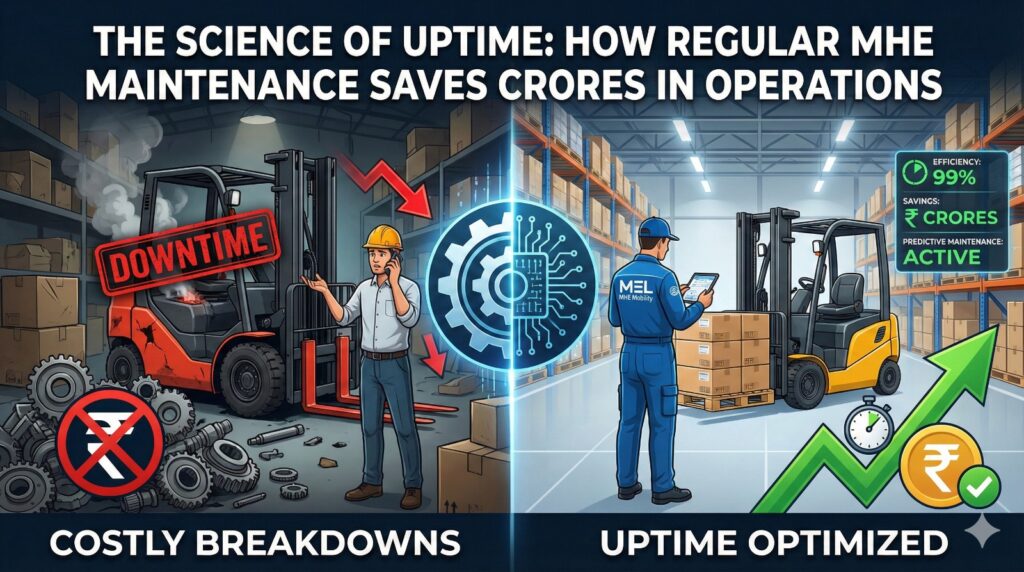
Today’s fast-moving manufacturing and warehousing environment, uptime is everything. A single forklift breakdown, a worn-out pallet truck wheel, or a malfunctioning reach truck can bring an entire production line to a standstill. And when operations stop, the losses are not just financial — they ripple across manpower, delivery schedules, customer commitments, and overall efficiency.
This is exactly why regular Material Handling Equipment (MHE) maintenance is no longer optional — it’s a strategic tool that safeguards productivity and profitability.
1. Uptime Isn’t Luck — It’s Science
Every MHE unit has predictable wear patterns. Forklift brakes, hydraulic systems, batteries, controllers, and mechanical components all degrade in a measurable way.
With timely maintenance, components are replaced before failure, ensuring equipment performance remains steady and reliable.
Factories that follow a preventive maintenance model consistently report:
- fewer breakdowns
- longer equipment life
- higher load-handling efficiency
- improved operator safety
This makes uptime a measurable, controllable outcome — not a gamble.
2. The True Cost of Breakdown Is Massive
Most organizations calculate repair costs but forget to include the invisible losses. A sudden MHE failure triggers:
- production stoppage
- labour idle time
- delivery delays
- emergency repair costs
- damage to goods caused by malfunctioning equipment
- increased energy usage for older, poorly maintained MHE
When all these factors combine, a single breakdown can cost lakhs — sometimes even crores — annually. Regular maintenance eliminates these avoidable disruptions.
3. Preventive Maintenance Extends Equipment Life
Well-maintained forklifts, stackers, pallet trucks, and reach trucks last significantly longer. Clean hydraulics, timely lubrication, battery care, and replacement of worn parts reduce mechanical stress.
Instead of replacing MHE prematurely, companies enjoy maximum value from their existing assets.
4. Better Safety, Better Productivity
Equipment failure is one of the biggest causes of on-site accidents.
Regular inspection ensures:
- stable lifting performance
- smooth braking
- accurate steering
- controlled hydraulics
- zero unexpected failures
Safe equipment is not just a compliance requirement — it boosts operator confidence and speeds up daily operations.
5. Data-Driven Maintenance: The Future of Uptime
Modern preventive maintenance uses service logs, performance patterns, and part life cycles to predict failures before they happen.
This approach leads to:
- planned downtime instead of surprise stoppages
- precise part replacement
- reduced maintenance overhead
- efficient fleet usage
It’s uptime powered by intelligence.
6. How MEL MHE Mobility Helps Industries Stay Operational
With 20+ years of expertise and a skilled team of service engineers, MEL MHE Mobility delivers:
- quick-response on-site service
- genuine, high-performance spare parts
- periodic and preventive maintenance plans
- expert diagnostics
- lifecycle-based component replacement
- reduced downtime through proactive care
This combination allows factories and warehouses to run at peak efficiency while avoiding costly operational interruptions.
7. Uptime Equals Profitability
The goal is simple:
Keep the equipment moving, and the business keeps growing.
Companies that invest in regular MHE maintenance consistently report:
- higher output
- smoother workflows
- reduced breakdowns
- lower total ownership cost
- better asset performance
Uptime directly impacts business profitability — and preventive maintenance is the smartest way to achieve it.
Conclusion
Regular MHE maintenance isn’t just a technical requirement — it’s a strategic business decision. By understanding the science behind uptime and partnering with experts like MEL MHE Mobility, organizations can protect their operations, prevent co